Drunk driving remains the #1 cause of fatalities on U.S. roadways, claiming more than 10,000 lives and costing the U.S. approximately $194 billion every year.
Our Work

Drunk driving remains a serious public health and safety issue. But what if we could use technology to invent a world without drunk driving? That’s the mission of the Driver Alcohol Detection System for Safety (DADSS) Program: a collaborative research effort to invent, test, and deploy new alcohol detection technologies for widespread use in commercial vehicles of the future.
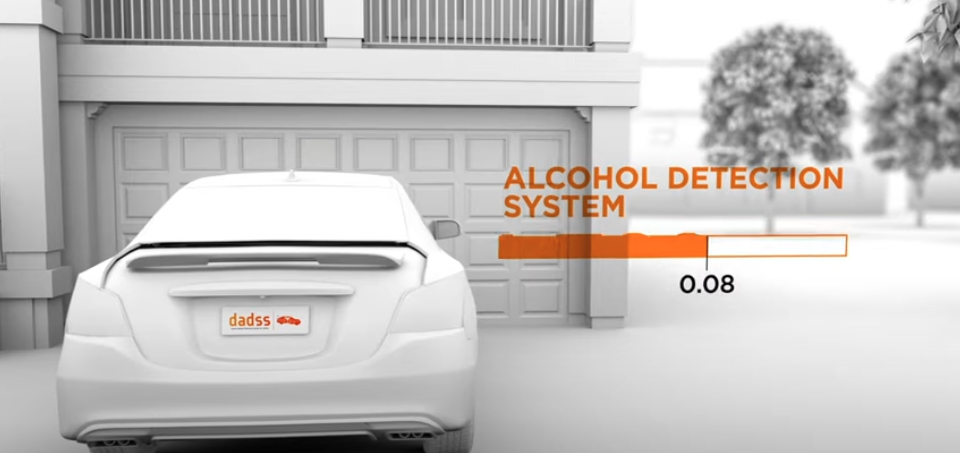
The goal is to advance the existing state of alcohol detection systems by developing a first-of-its-kind technology that can passively detect when a driver is under the influence of alcohol. The technology is being designed to measure and precisely quantify a driver’s blood alcohol concentration (BAC) and if it is at or above the legal limit—0.08 in most states – prevent a vehicle from moving. This breakthrough technology is designed to be fast, accurate, reliable, and affordable – all without affecting normal driving behavior.
Read our Frequently Asked Questions for more information on the development process and how the technology works.
About DADSS
The Driver Alcohol Detection System for Safety (DADSS) Research Program brings together the Automotive Coalition for Traffic Safety (ACTS), which represents the world’s leading automakers, and the National Highway Traffic Safety Administration (NHTSA), in one of the most important government and private sector partnerships in transportation history. Public-private partnerships like DADSS have led to innovations that enhance our everyday lives, such as the Internet, GPS and the microchip.
Bipartisan leaders in Congress and safety advocates nationwide are supporting the effort, making DADSS part of a multi-faceted national commitment to reduce and help eliminate drunk driving. The research is being overseen by a team of independent engineers and scientists and being tested under real-world operating conditions before being made available for widespread use in commercial vehicles of the future.


Technologies We're Exploring


Breath System

Touch System
Program History & Timeline
The DADSS Program began in 2008 and was focused on researching and creating proof-of-concept prototypes to determine which technological approaches were most promising for vehicle integration. After extensive research, it was determined that a breath system and touch system were most viable.
Since that time, the Program has focused on ensuring the technology meets strict performance specifications related to accuracy, precision and reliability, so sober drivers are not inconvenienced, and so drunk drivers are never allowed to operate the vehicle.
In 2018, Virginia became the first state to partner with the DADSS Program for the first trial deployment of vehicles through an initiative called Driven to Protect. This successful initiative is expanding to other states for in-vehicle, on-road test trials of the breath technology with sober drivers in naturalistic settings. That same year, the Program expanded on-road testing to include controlled, in-vehicle tests with drinking passengers, to determine how the sensors respond to real-world conditions. Those tests continue today through the Harvard University-affiliated McClean Hospital.
In 2021, the Program announced the first-generation system equipped with the breath technology is being made available for open-source commercial licensing in fleet vehicles for the first time. ACTS will license the breath technology to any existing fleet or company that wants to outfit it into their vehicles – whether it be public or private transportation vehicles, government fleets, rental cars, trucking companies, etc. This system is designed for fleet operators implementing a zero-tolerance alcohol policy for their drivers.
Also in 2021, the Program announced a trial deployment of the DADSS technology with truckload carrier Schneider. This partnership is generating hundreds of thousands of real-world operating miles, increasing the stress that the breath system is put under on the road, and exposing the system to new drivers and a wider range of environmental conditions — all key to the DADSS Program’s quest to commercialize fully passive vehicle-integrated breath technology.
Today, teams of engineers, chemists and data scientists are working to reduce the size of the sensors so they are small enough to fit into passenger vehicles, can withstand harsh environmental conditions, do not require extensive calibration and can last the entire lifetime of a vehicle. Previous transportation safety innovations like airbags have taken a minimum of 20 years to be tested and approved for the public’s use, and the DADSS Program is on track to be completed in less time. For more information on when the technology might be made available in consumer vehicles, click here.